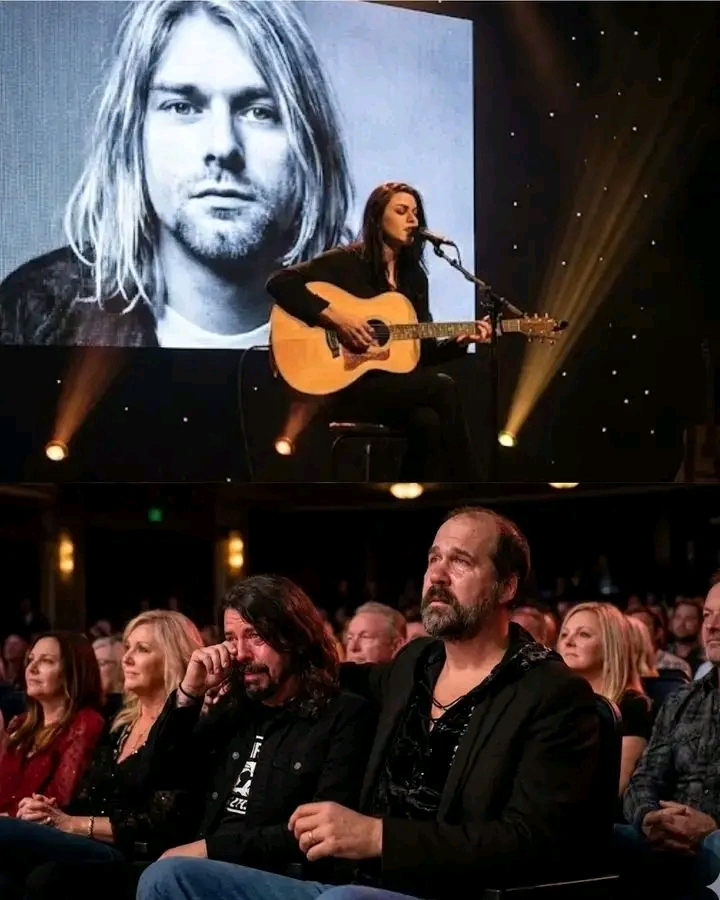
“HE BUILT HIS CAREER ON NOISE — BUT LAST NIGHT, SILENCE WAS LOUDER.”
He built his career on noise — walls of distortion, feedback howling like sirens, drums that sounded like the end of the world. For years, the name Kurt Cobain was synonymous with volume — not just sonic volume, but cultural force. As the frontman of Nirvana, he helped detonate the polished excess of the late ’80s and usher in something raw, ragged, and painfully honest. Songs like “Smells Like Teen Spirit” didn’t whisper; they erupted. The noise wasn’t accidental. It was armor. It was protest. It was survival.
But last night, silence was louder.
At a quiet charity show in Los Angeles, the crowd didn’t gather for a spectacle. There were no towering amps, no tidal waves of distortion. Instead, there were candles, soft stage lights, and the unmistakable weight of memory. The event supported mental health initiatives — a cause that felt less like philanthropy and more like personal reckoning.
When Frances Bean Cobain stepped onto the stage, the room shifted. She doesn’t carry her father’s rasp or his slouch, but she carries something heavier: the echo of a legacy that refuses to fade. For decades, the world has spoken about her father in thunderclaps — icon, martyr, voice of a generation. Rarely has it paused for quiet.
She didn’t perform a grunge anthem. She didn’t attempt to recreate the past. Instead, she spoke. Her voice was steady but intimate, the kind of tone that makes a large room feel like a living room. She talked about grief as something that evolves, about learning to separate myth from memory. She talked about compassion — for those who struggle loudly and those who struggle in silence.
And in that stillness, the absence of noise felt enormous.
For so long, Kurt Cobain’s story has been told at maximum volume — tabloid headlines, documentaries, endless retrospectives dissecting his final days in Seattle. His pain was amplified, replayed, commodified. The distortion never really stopped. Even decades after his death, the cultural machine hums on.
But last night wasn’t about the machine. It was about the human cost of turning anguish into art — and art into mythology.
There’s something striking about the daughter of a man who weaponized noise choosing restraint instead. Frances didn’t try to compete with the legend. She didn’t need to. In the quiet, she reclaimed something the world rarely grants public figures: complexity. She reminded the audience that behind every icon is a family, behind every anthem is a person who once sat alone with a guitar and a head full of chaos.
The applause, when it came, was soft at first — almost reverent. No one wanted to break the spell. It wasn’t the kind of roar that follows a power chord. It was the sound of recognition.
He built his career on noise. But in that Los Angeles room, noise felt beside the point. What lingered wasn’t distortion or feedback. It was the courage to speak gently about something that once screamed.
And somehow, that silence said more than any amplifier ever could.
Leave a Reply